
Marketplace & Integrations
Product Manager
Overview
When I joined Personio, integrations were still very early. A few customers had built things on top of the public API, but there was no real product strategy behind it: no dedicated team, no partner model, and no clear place for customers to discover what existed.
Over the next three years, I helped turn integrations from an edge topic into a real product area and a meaningful part of Personio's commercial story, while the company scaled from roughly 300 to 2000+ employees.
The key product calls
-
Sales pain vs. platform idealism
Customers — especially in the mid-market — were regularly asking for integrations with tools like Slack, Microsoft Teams, and Azure AD. These were often deal-breakers.In theory, the neat platform answer would have been to let partners build everything. In practice, that was too slow. The partner ecosystem was immature, the API was not ready enough, and the business could not afford to wait. We had to be deliberate about which integrations Personio should build itself and where we should invest in partner enablement.
-
No single place for integrations to live
Even when integrations existed, customers had no central place to find them, understand them, or activate them. That made the whole topic harder than it needed to be for sales, for customers, and for partners. -
How to scale without building everything ourselves
We knew from the start that Personio should not build the entire long tail in-house. The leverage would come from partners, but that only works if the platform is worth building on and the process around partnerships is clear.
What I focused on building
-
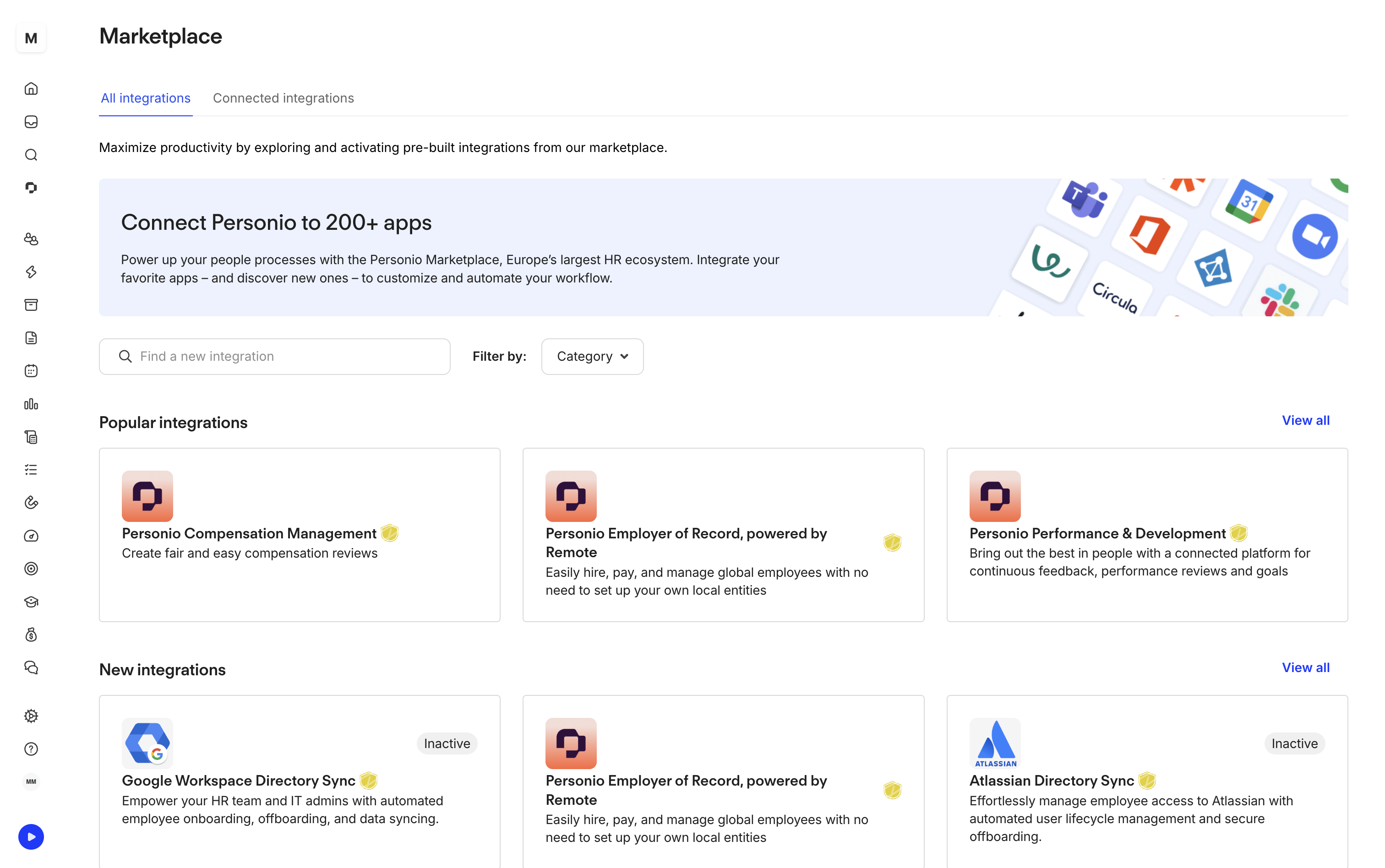
Personio Marketplace as a platform
We built the public and in-app Marketplace as the central home for integrations. I always thought about it less as a catalog and more as a product funnel:- discovery had to be clearer, so customers could quickly find relevant integrations
- evaluation had to be stronger, so they understood what an integration did and whether it fit their setup
- activation had to be smoother, so interest actually turned into usage
-
A deliberate build vs. partner strategy
We established a simple principle:- Personio builds a small set of “must-have” integrations that are critical for winning and retaining customers (e.g., Slack, Teams, Azure AD, Okta).
- Partners build the long tail, supported by a stronger platform.
-
Bootstrapping partnerships from scratch
There was no real Technical Partner Management setup when I started. I helped define how partners were onboarded, what a good integration looked like, and how the work could become a repeatable motion instead of a series of custom projects. -
Making the platform actually usable for developers
We also improved the underlying developer experience: API credential management, a proper Developer Hub, and improvements to the Public API. Those foundations mattered because the marketplace would only scale if third parties could actually build on top of Personio without unnecessary friction.
What this enabled
- Grew the ecosystem from fewer than 20 ad hoc integrations to 200+ listed integrations.
- Turned integrations from a recurring sales objection into a stronger part of Personio's value proposition.
- Established a model where Personio built the critical few and partners could cover the long tail on top of a stronger platform.
What I still like about this project is that it forced a fairly fundamental product decision: where do we want to be opinionated and build ourselves, and where do we want to enable an ecosystem? A lot of the work was really about aligning product strategy, partner strategy, and developer experience so they reinforced each other.