
Workflow Automation
Senior Product Manager
Overview
In mid-2023, I moved into Personio's Workflow Automation team to help take the product from an early prototype to something customers could actually rely on.
By then, Automation had already been positioned as a major strategic bet for the company. The challenge was no longer to explain why workflow automation mattered. It was to turn an ambitious concept into a product that HR teams could understand, trust, and actually use.
The key product calls
-
How powerful should a “no-code” tool really be?
This was the core product tension. The more flexible the builder became, the easier it was to overwhelm users. But if we simplified too aggressively, we would end up with something too narrow to matter. We had to find the point where the product was powerful enough for real HR workflows without becoming intimidating. -
How do we help people get started without a blank canvas?
Starting from scratch is hard, especially in a product category that already feels complex. We needed to reduce that first-use friction without taking away flexibility. -
How do we build trust in automation?
HR workflows often touch sensitive, high-stakes processes. If customers could not understand what a workflow had done, they would hesitate to automate anything important. Trust was not a nice-to-have here. It was the condition for adoption.
What I focused on building
-
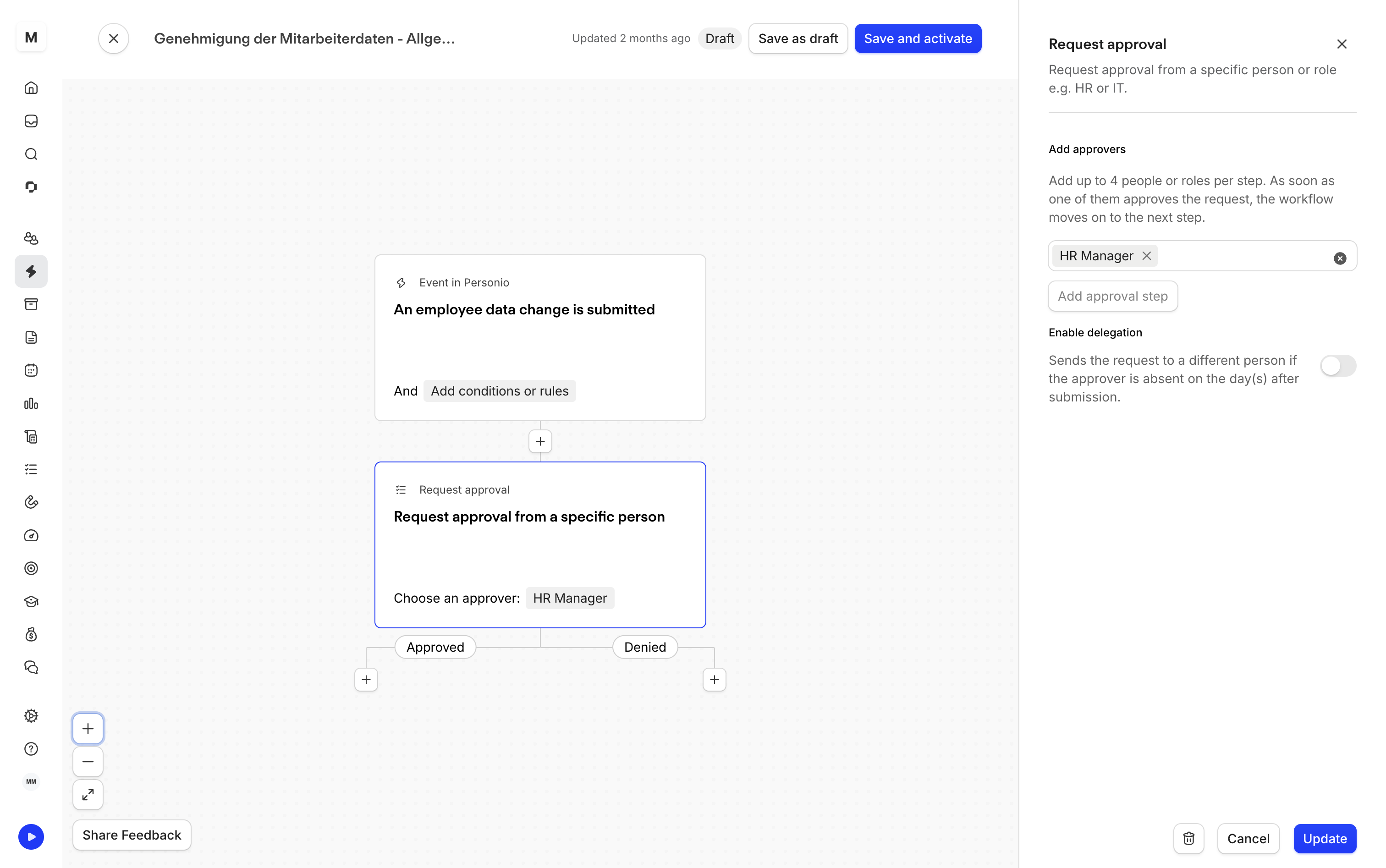
A flexible, visual Workflow Builder
We matured the builder into a much clearer visual experience, including a move to React Flow. That improved the canvas interaction, but more importantly it made workflows easier to read, edit, and reason about once they got more complex. -
Workflow Template Gallery
I led the introduction of a template gallery for common HR use cases. This solved an important adoption problem:- they could launch quickly with a proven setup, or
- use a template as a base and adapt it to their own process.
-
Workflow Activity (Execution Log)
To build trust, we introduced a detailed activity view that showed what a workflow had done step by step. That transparency mattered a lot. It helped with troubleshooting, but it also made customers more comfortable turning automation on in the first place.
After launch, I also took over Document Management and E-Signature, two of Personio's most widely used core features. That extended the scope beyond the 0 to 1 Automation product, but the underlying theme stayed the same: reduce manual coordination work and make important operations easier to follow.
What this enabled
- Helped take Automation from an early prototype to a launched product used by thousands of customers.
- Made workflow automation usable for HR teams without requiring technical implementation support.
- Improved adoption by giving customers better starting points and much clearer visibility into what the system was doing.
For me, the interesting part of this project was that it was never just about shipping a builder. It was about deciding what level of power was actually useful for this audience, and then designing the product so customers felt confident enough to use it on real HR processes.